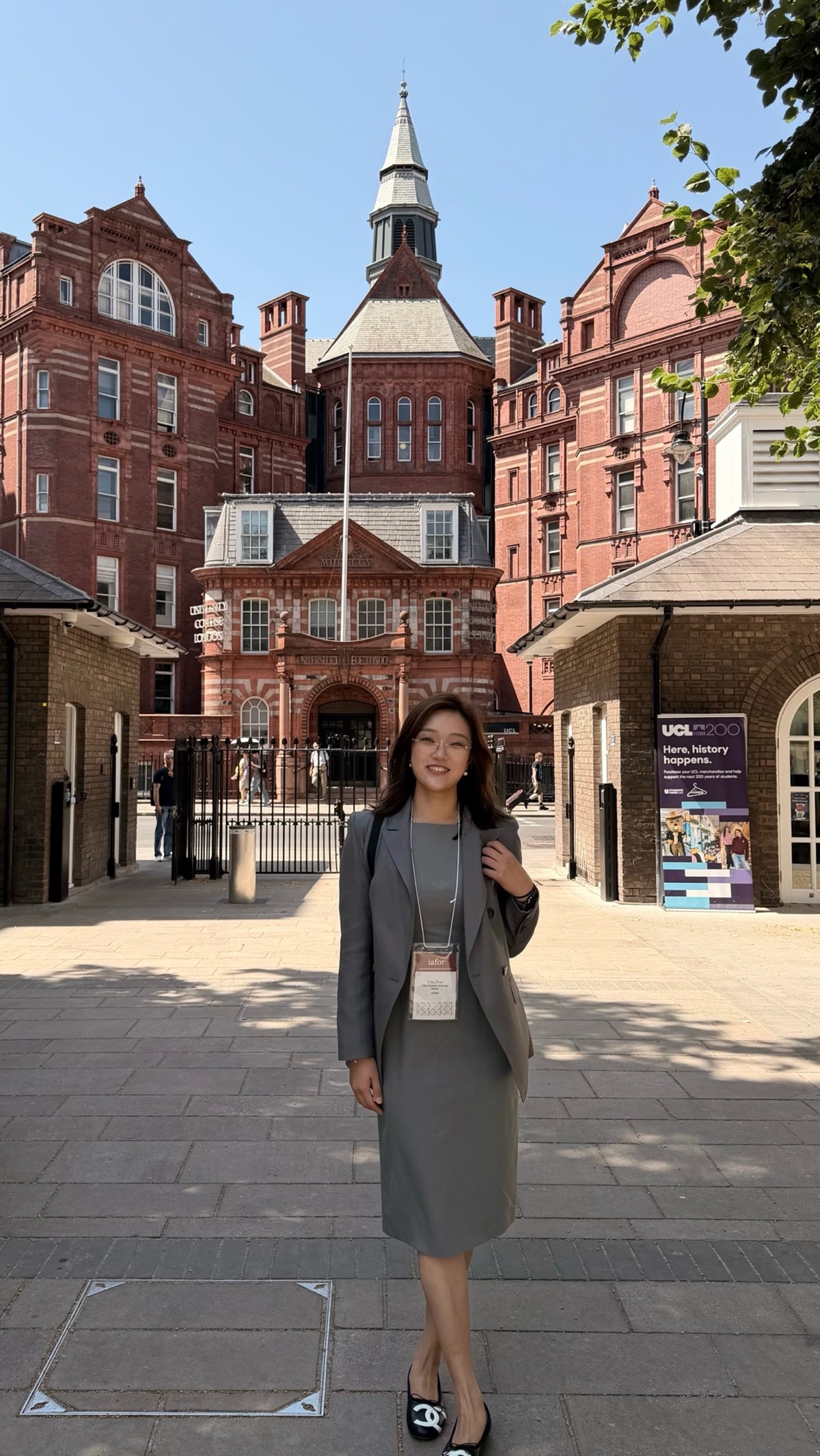
Dr. Zhao had the pleasure of attending the 14th European Conference on Education (ECE2026) in London, organised by The International Academic Forum (IAFOR) and held at SOAS University of London and University College London (UCL) in July. The conference brought together 609 delegates from 80 countries, the conference welcomed researchers working across educational policy and leadership, higher education, curriculum design, AI in education, international education, and many other fields, embodying IAFOR’s mission of international, intercultural, and interdisciplinary exchange.
On the morning of Sunday, 12 July, Dr. Zhao presented her paper, “Governing Glocalized Internationalization: Comparative Institutional Mechanisms Across Chinese University Types” as an oral presentation in the Education Policy and Administration session at UCL. The paper examines how China’s three statutory types of universities among public, private, and Sino-foreign cooperative, govern internationalisation at home. Drawing on market design theory and glocalization theory, and on documentary, interview, and observational evidence, the study asks why institutions facing one regulator and one set of isomorphic pressures nonetheless walk three systematically different pathways. The central argument is that the stability of each type’s matching markets is set by its structural position and that a useful distinction can therefore be drawn between mechanism-level designs that can travel across systems and guarantees that remain structurally bound. The presentation prompted a lively discussion on the applicability of matching theory to transnational higher education and on Macau’s distinctive position outside the mainland classification.
Beyond her own session, the conference offered an inspiring opportunity to hear cutting-edge research and to exchange ideas with scholars from around the world; some of the most stimulating conversations happened informally over coffee between sessions. As a researcher based in Macau, Dr. Zhao was struck by how strongly the question of balancing the global and the local resonates across higher education systems, and by the analytical value of Macau’s unique institutional vantage point. The experience has expanded her international academic network and generated fresh material for our School’ s research and teaching in the internationalisation of higher education and in assessment and evaluation. Dr. Zhao is sincerely grateful to the School of Education for its support of international academic exchange, and she looks forward to bringing what she learned in London back to her classroom and research. Her thanks also go to IAFOR and the organising committee for creating a conference that genuinely values rigorous scholarship, interdisciplinary dialogue, and international collaboration.